Chapter 2 || ProductFlo Manifesto
ProductFlo reinvents engineering by embedding a proprietary AI copilot, “Haitch,” at its core—enabling engineers to automate, generate, and coordinate complex design and code. Built natively from first principles, the platform fuses AI and engineering data for deep understanding, letting teams focus on creativity and high-level problem solving while the AI handles the heavy lifting across disciplines.
A note from the ProductFlo team — September 2026: This post is from October 2025 and describes an earlier direction: a proprietary AI copilot ("Haitch") inside a cloud PLM built from first principles. We've since pivoted. ProductFlo is now the orchestration layer for mission-critical hardware engineering — governed AI agents that work across your existing tools, with a human approving every change. We're keeping this post up for transparency. See where we are now →
Rethinking the product development process: Engineers with an AI Copilot
ProductFlo’s foundation is a question we asked ourselves from the outset: What if every engineer had an intelligent copilot, a tireless, super-smart agent that could handle the grunt work, seamlessly connect disciplines, and even generate code or CAD geometry on the fly? Instead of adding yet another layer of UI on top of legacy kernels, we started from first principles. We envisioned the engineering workspace not as a static set of drawing tools, but as a conversation between the human engineer and a powerful AI assistant.
This assistant, affectionately named “Haitch” (the phonetic for the letter H, as in Hardware), is at the core of ProductFlo’s generational leap.
So, what exactly is Haitch?
Haitch stands for: Heuristic AI Technical Companion for Hardware
Haitch is an AI agent embedded in the ProductFlo platform, designed to act like a senior engineer who never sleeps. It can write and read code, generate and interpret complex design files, reason through engineering problems, and coordinate tasks across mechanical, electrical, firmware, and even manufacturing domains. In practice, Haitch might draft a CAD model based on a verbal description, generate a wiring diagram to match a mechanical layout, or review a thermal simulation and suggest design tweaks – all through intelligent automation and dialogue with the user.
This represents a stark contrast to the old paradigm. Traditional tools were built for engineers who aren’t programmers; ProductFlo is built around an engineer who actually is a programmer – an AI programmer, that is. Haitch can literally extend what your team knows and can do.
If you ask Haitch to, say, “Add a heat sink to this design and ensure the component temperatures stay under 60°C,” it can interpret that high-level request, modify the 3D model, run a thermal analysis, and report back the results. It’s as if your CAD, analysis, and coding software all rolled into one entity that understands your goals. You’re no longer pushing every button yourself; you’re guiding an AI that can execute many tasks autonomously.
Crucially, ProductFlo didn’t just slap an “AI assistant” label on an existing tool; we built Haitch and the platform together as one integrated system. This is a native, first-principles architecture, not an after-market plugin. Why does that matter?
Because the biggest challenges in applying AI to engineering (like understanding spatial geometry or circuit logic) required us to deeply fuse AI with engineering data at the core. A hint of how far we took this: Haitch isn’t powered by a generic large language model; it’s backed by a proprietary 7-billion-parameter semantic engine fused with a vision encoder, trained and fine-tuned specifically for engineering contexts.
In other words, we taught Haitch the “language” of CAD, schematics, and BOMs, not just human conversation.
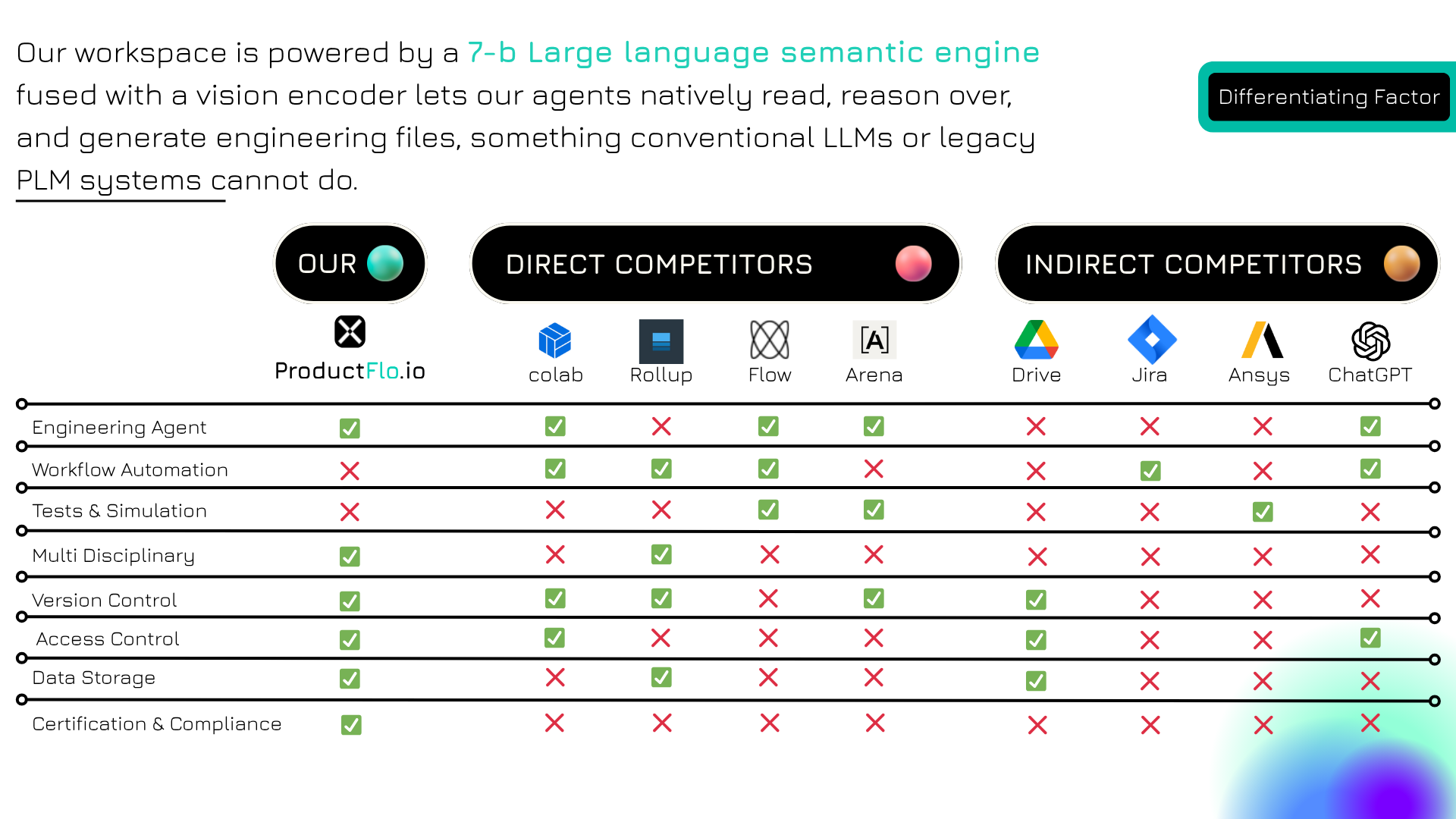 ProductFlo Differenciating Factor Table
TLDR: Key Takeaways
- ProductFlo reimagines engineering tools by embedding an AI copilot (“Haitch”) at the core, not as an add-on.
- Haitch acts as a tireless, senior engineer: it can generate code, CAD, schematics, and automate complex tasks across disciplines.
- The platform is built from first principles, fusing AI and engineering data natively for deep understanding of geometry, logic, and design intent.
- Engineers interact with Haitch through natural conversation, enabling high-level requests and rapid iteration—no more manual button-pushing.
- Haitch is powered by a proprietary, engineering-trained AI model that understands the “language” of CAD, schematics, and BOMs.
- ProductFlo’s approach enables engineers to focus on goals and creativity, while the AI handles the heavy lifting and cross-domain coordination.
Stop bad hardware changes before they ship.
30-day pilot on one active product. Fixed $8k. Live on your own BOM in week one.