Chapter 3 || ProductFlo Manifesto
Discover how ProductFlo’s custom AI copilot, Haitch, uses multimodal learning and engineering-specific training to reason, automate, and generate real design files—transforming engineering workflows beyond traditional CAD/PLM tools and unlocking an intelligent, collaborative future for hardware development.
A note from the ProductFlo team — September 2026: This post is from October 2025 and describes an earlier direction: a proprietary AI copilot ("Haitch") inside a cloud PLM built from first principles. We've since pivoted. ProductFlo is now the orchestration layer for mission-critical hardware engineering — governed AI agents that work across your existing tools, with a human approving every change. We're keeping this post up for transparency. See where we are now →
How Haitch Works: Teaching an AI to Think Like an Engineer
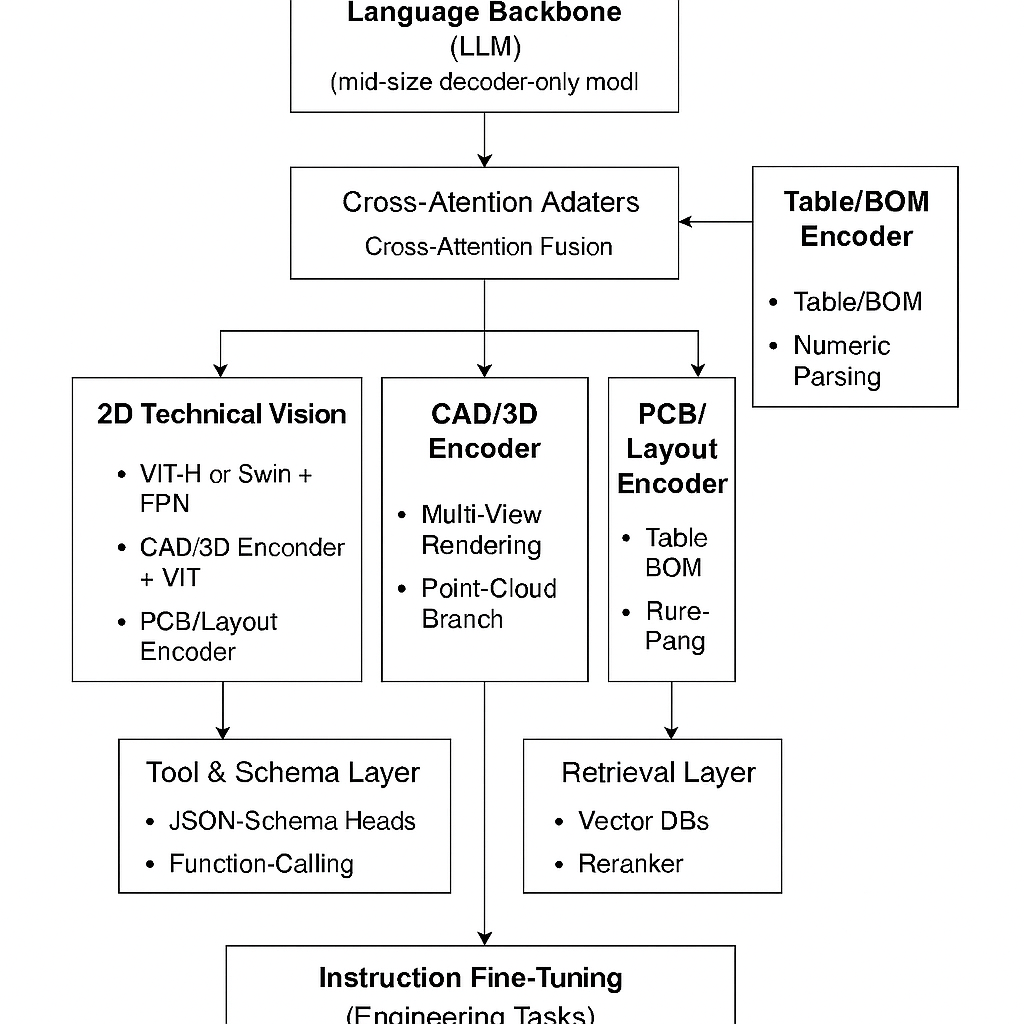
Under the hood, ProductFlo’s AI architecture embodies a breakthrough in transfer learning for engineering. We started with advanced foundation models (the kind used in natural language processing and vision) and then trained and augmented them to reason in ways traditional LLMs cannot. Haitch’s brain is essentially a custom LLM that has been engineered for engineers.
Here’s what makes it special:
Multimodal Understanding
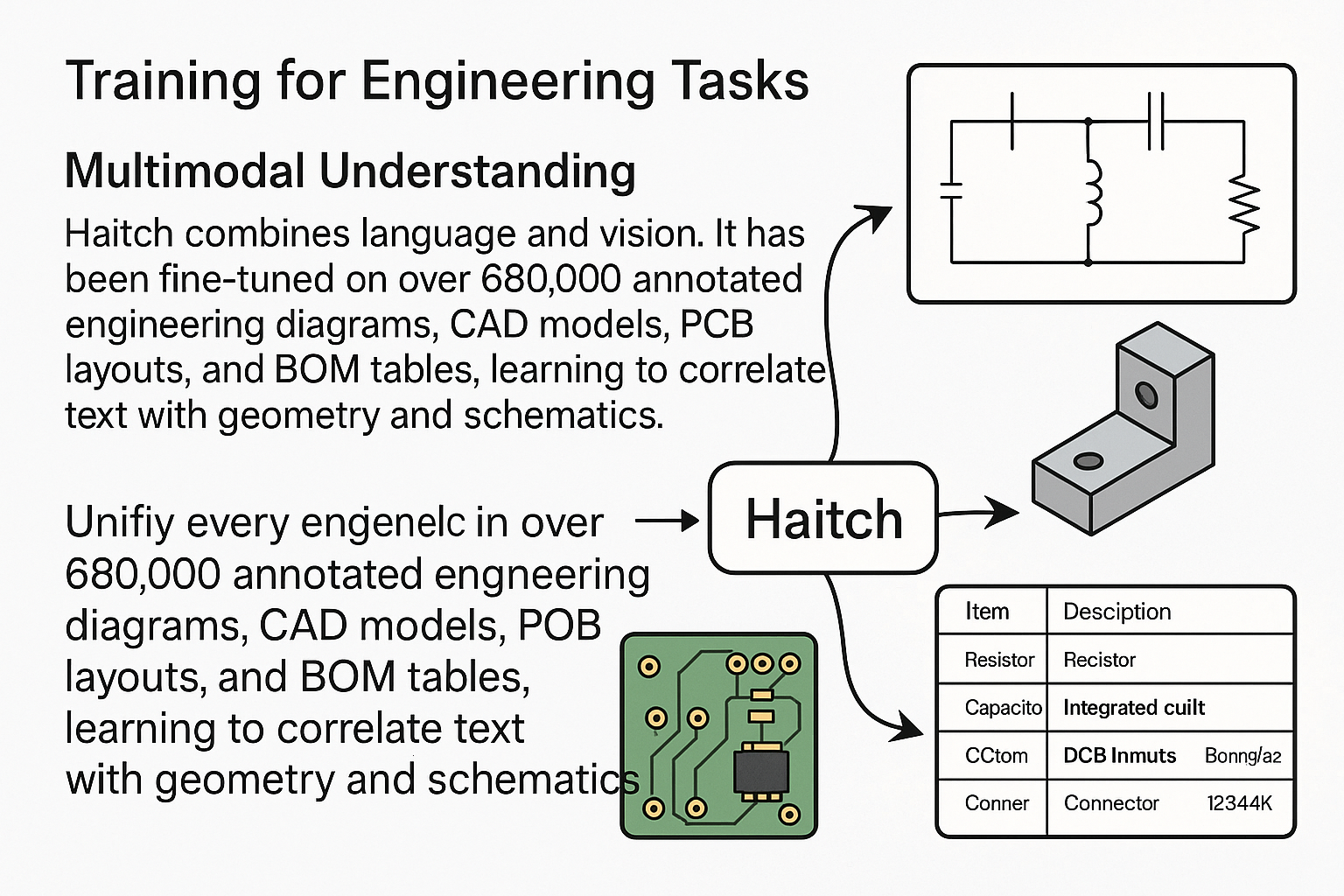
Haitch combines language and vision. It has been fine-tuned on over 680,000 annotated engineering diagrams, CAD models, PCB layouts, and BOM tables, learning to correlate text with geometry and schematics. It doesn’t just interpret plain text prompts; it can “see” and parse engineering drawings or 3D model data. For instance, show Haitch a 3D assembly and it can identify components, spatial relationships, and even potential issues, because it has learned from countless examples what engineering designs look like.
Discipline-Specific Knowledge
Through transfer learning on domain-specific data (and reinforcement learning from human feedback on actual engineering tasks), Haitch has developed an engineering common sense. It knows the difference between a microcontroller and a MOSFET on a PCB, or between a bolt and a pin in a CAD assembly. It has absorbed not just textbook knowledge, but practical rules of thumb (from DFM guidelines to typical certification checklists). We even incorporated real build and test results into the training loop, so the model learns what design decisions led to successful outcomes versus failures. This is key to bridging the gap between theoretical knowledge and practical engineering reasoning.
CAD-Aware Reasoning
Perhaps most impressively, Haitch can directly read and generate engineering file formats – something off-the-shelf AI models simply cannot do. ProductFlo exposes a CAD-aware API to the AI, meaning Haitch can manipulate geometry or circuit data in a native way. No incumbent PLM or CAD system in existence offers this kind of built-in generative model capability. For example, Haitch could take a partial CAD design and complete it, adding features by effectively writing the CAD “code” under the hood. Or it could examine a PCB layout file and reason about trace lengths or power integrity issues. This deep integration of AI with the actual engineering data structures is like giving the AI hands to work inside the design, not just eyes to look at it.
Output Results
What all this yields is an AI agent that doesn’t just regurgitate Wikipedia facts or chat platitudes – it actually “thinks” like an engineer within the context of your project. Haitch can weigh trade-offs (mechanical vs electrical, cost vs performance), follow procedural logic (e.g. test protocols, regulatory steps), and even debug issues by tracing through design and code. If a simulation result is off, Haitch can suggest which design parameter might be responsible. If a part in your BOM goes end-of-life, Haitch can flag it and propose an alternative from the supplier database. This is beyond any static expert system; it’s a learning, reasoning entity embedded in your workflow.
By building Haitch into the core, ProductFlo has effectively turned the traditional CAD/PLM software model on its head. Instead of a human manually operating a complex software tool, you have an AI operating the software and collaborating with the human. The UI is no longer the star of the show – it’s there to facilitate communication between you and Haitch. In fact, a lot of the heavy lifting happens with no UI at all, behind the scenes or via a chat interface. That’s a fundamental shift in how we conceive of “using” engineering software.
TLDR: Key Takeaways
- Haitch is a custom, multimodal AI agent built specifically for engineering, combining language and vision to understand and generate CAD, PCB, and other technical data.
- It leverages transfer learning and reinforcement from real engineering tasks, giving it practical, discipline-specific knowledge and engineering “common sense.”
- Haitch can natively read, interpret, and generate engineering file formats—enabling it to reason about and manipulate designs at a deep, structural level.
- The AI is tightly integrated with ProductFlo’s platform, allowing it to automate, debug, and optimize engineering workflows, not just answer questions.
- ProductFlo’s approach flips the traditional CAD/PLM paradigm: instead of humans operating software, an AI agent collaborates with engineers, handling much of the complexity behind the scenes.
Stop bad hardware changes before they ship.
30-day pilot on one active product. Fixed $8k. Live on your own BOM in week one.