Chapter 4 || ProductFlo Manifesto
ProductFlo replaces the tedious, button-driven workflows of legacy CAD/PLM tools with a fluid, AI-powered experience—automating repetitive engineering tasks through natural language and unified collaboration, so teams can focus on solving problems instead of operating software.
A note from the ProductFlo team — September 2026: This post is from October 2025 and describes an earlier direction: a proprietary AI copilot ("Haitch") inside a cloud PLM built from first principles. We've since pivoted. ProductFlo is now the orchestration layer for mission-critical hardware engineering — governed AI agents that work across your existing tools, with a human approving every change. We're keeping this post up for transparency. See where we are now →
From GUI Grind to Fluid Workflows: No More Button-Based Busywork
One of the most immediately noticeable changes in ProductFlo’s approach is the drastic reduction of “button-click bureaucracy.” In legacy tools, every little action – from extruding a feature in CAD to updating a material property – requires a series of clicks and dialog boxes. Engineers often joke about being professional CAD operators rather than designers, because so much time is spent wrestling the tool. ProductFlo liberates you from that tedium. By delegating low-level tasks to the AI agent, engineering workflows become far more fluid, conversational, and automated.
Gone are the days of hunting through nested menus or performing repetitive actions across multiple disconnected software. Many traditional interface elements can be replaced by simple instructions to Haitch. For example, instead of manually opening a BOM spreadsheet, looking up part numbers, cross-checking supplier websites for stock, and then updating a BOM tool, you could simply tell Haitch: “Update any resistor in this design that is out of stock to an equivalent available part.” Haitch understands the request, checks the live supplier data, updates the BOM accordingly, and even notifies the electrical engineer and supply chain manager of the change. All of that happens without you painstakingly clicking through different applications and forms – the agents orchestrate it through code and reasoning.
A Parallel Example
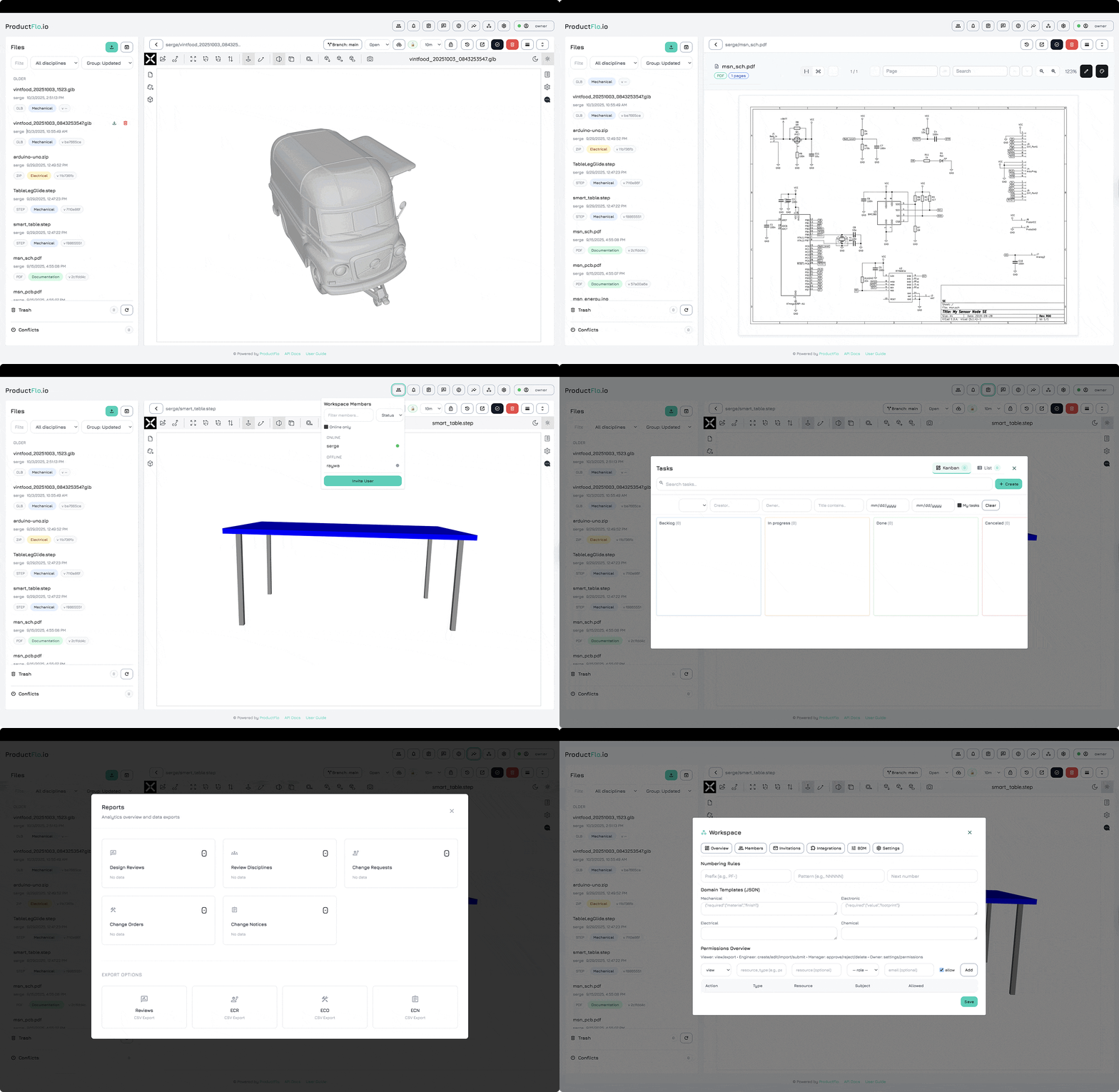
Consider another scenario: performing a design review. Traditionally, you’d generate PDFs or screenshots of your CAD, email them around or upload to a shared drive, collect feedback in a meeting or via marked-up docs, then manually implement changes. In ProductFlo, by contrast, you can have a real-time design review that feels like a collaborative Google Doc session – except Haitch is also present as an assistant. Team members can comment in a unified workspace, and Haitch can interpret these comments and even make certain changes automatically or prepare an action list. If someone writes, “This enclosure wall looks too thin for structural integrity,” Haitch might flag the wall’s thickness in the model and suggest increasing it (along with recalculating weight and cost impacts). The UI isn’t a hindrance; it’s a canvas for collaboration, with the AI smoothing out the process.
Importantly, this isn’t just about convenience – it’s about eliminating whole classes of human error and delay. When workflows are intelligent and connected, you no longer suffer from version mismatches, forgotten updates, or “oops, I used an outdated drawing” mistakes. ProductFlo’s AI ensures there is a single source of truth and that whenever something changes, the ripple effects are handled. For instance, if a mechanical engineer shortens a chassis and that affects a PCB outline, Haitch will catch it and alert the PCB designer immediately (or even adjust the PCB layout if possible), because the mechanical and electrical designs live in one unified model. The platform replaces the brittle, manual handoffs with automatic synchronization. It’s like moving from sending letters via post to having a shared real-time document – the information flows instantly and intelligently.
Results
By removing the need for a rigid, button-driven UI, ProductFlo also opens the door to more natural interactions with engineering data. You can converse with Haitch in plain language, ask questions about the design (“What’s the total weight of this device and which component contributes most?”), or request analyses on the fly (“Run a quick FEM on this bracket to estimate its deflection under 10 kg load”). Haitch will translate those requests into actions using the appropriate tools or internal models and give you results, often in seconds. The experience is much closer to pair-programming or having a knowledgeable teammate, rather than operating a piece of software. It feels organic and responsive, not mechanical.
In short, ProductFlo takes the focus off the tool and puts it back on the task. Engineers can spend more time actually engineering – thinking creatively, solving problems, evaluating ideas – and less time doing the software equivalent of paperwork. The death of the button-based UI doesn’t mean no interface at all; it means the interface is whatever it needs to be to serve the engineer’s intent. Sometimes that’s a chat with Haitch, sometimes a live 3D model everyone annotates together, sometimes an automatically generated report that ProductFlo produces for you. The key is flexibility and intelligence, rather than forcing every workflow through the same manual steps. It’s as big a step change as moving from command-line coding to modern IDEs with autocompletion and automated testing – once you’ve experienced it, going back to the old way feels unthinkable.
TLDR: Key Takeaways
- ProductFlo eliminates the GUI-driven “button-click bureaucracy” of legacy CAD/PLM tools, dramatically reducing manual, repetitive actions in engineering workflows.
- Engineers can interact with the AI agent (Haitch) using natural language to automate low-level tasks, retrieve information, and coordinate actions, freeing them from tedious software operations.
- Collaborative workflows become faster and less error-prone: design reviews, BOM updates, and cross-disciplinary changes are handled in real-time with a single source of truth.
- Intelligent automation enables immediate feedback, reduces handoff mistakes, and ensures that ripple effects of design changes are managed system-wide—without manual intervention.
- The focus shifts from operating tools to solving engineering problems creatively, with the interface adapting to serve the engineer’s intent, whether through chat, shared models, or auto-generated reports.
- ProductFlo represents a generational leap—from rigid, tool-centered processes to flexible, fluid, AI-orchestrated engineering, making the old manual ways obsolete.
Stop bad hardware changes before they ship.
30-day pilot on one active product. Fixed $8k. Live on your own BOM in week one.