ProductFlo vs. CoLab: Design Review or Engineering Orchestration?
ProductFlo and CoLab both apply AI to hardware design review. Compare CAD collaboration, engineering knowledge, cross-discipline impact, integrations, security, pricing, and fit.
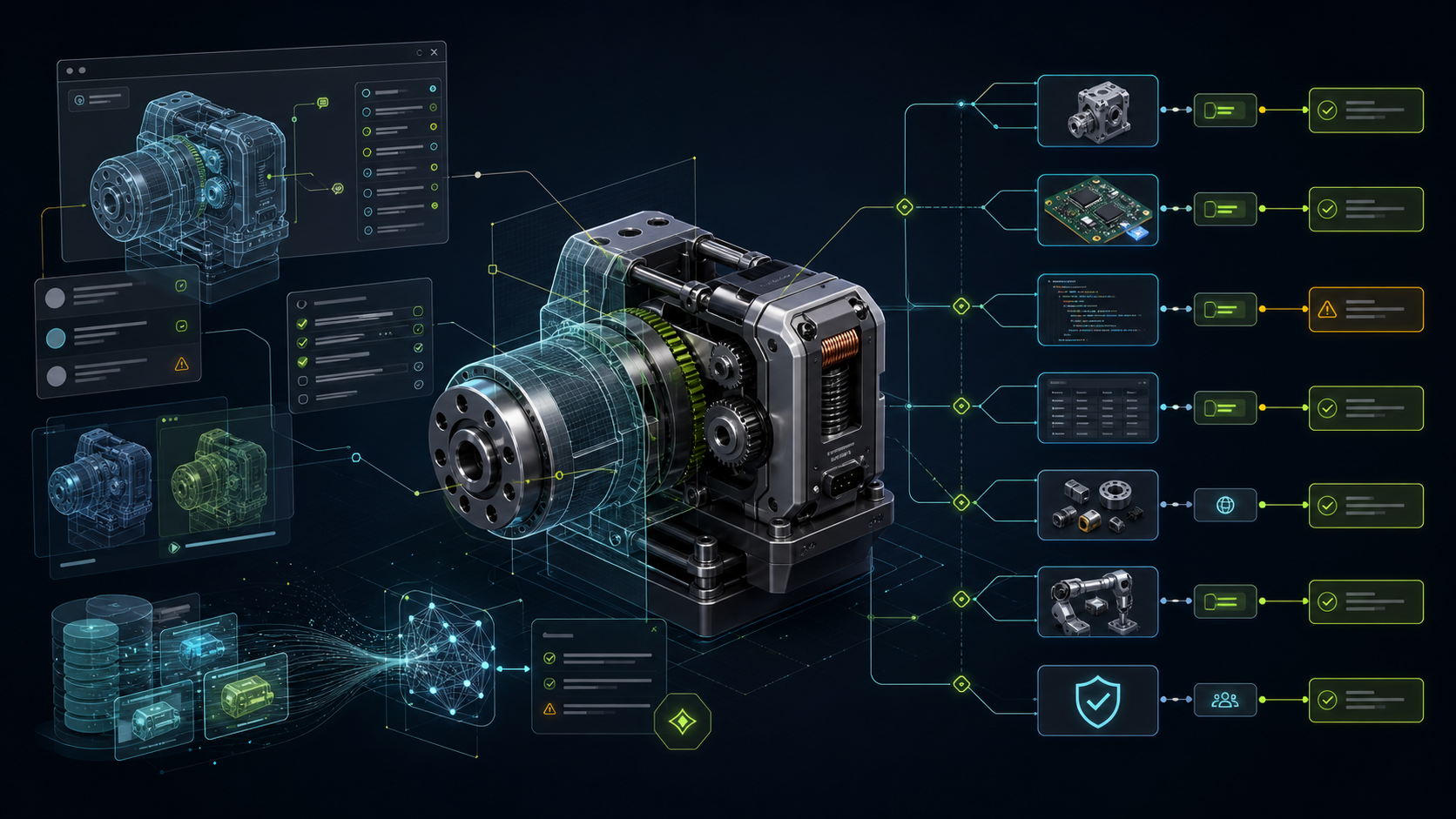
ProductFlo and CoLab both promise to improve hardware design review with AI. Both connect engineering information that would otherwise be scattered across specialist tools. Both aim to catch problems earlier, preserve decisions, and keep people in control of consequential changes.
That overlap is real, but it can hide the more important difference.
CoLab is centered on the review itself: opening CAD and drawings in a browser, collecting contextual feedback, tracking issues, and turning past reviews and standards into reusable engineering knowledge. ProductFlo is centered on the product dependency model around the review: indexing mechanical, electrical, firmware, BOM, supplier, and manufacturing artifacts so agents can analyze cross-discipline impact and propose governed changes.
In simple terms, CoLab asks, “How can everyone review this design more effectively, and how can the next review benefit from what we learned?” ProductFlo asks, “What does this proposed change affect across the product, and how can we turn that analysis into a controlled engineering change?”
This comparison reflects public product information reviewed on August 18, 2026. Capabilities, integration status, AI availability, security attestations, and commercial terms can change, so verify anything material during procurement.
Disclosure: This article is published by ProductFlo. We have linked to CoLab's first-party materials, corrected claims that were no longer current, and separated published facts from our interpretation. You should still test both platforms on the same real engineering review before buying either one.
The short answer
Choose CoLab when the immediate bottleneck is the design-review process: CAD and drawings are difficult to share, feedback gets trapped in meetings and slide decks, review issues are manually tracked, suppliers lack access to specialist tools, or lessons learned repeatedly disappear between programs.
Choose ProductFlo when the immediate bottleneck is cross-discipline change: a mechanical change can invalidate an electrical constraint, firmware assumption, BOM line, supplier decision, manufacturing instruction, or compliance artifact, and engineers spend too much time reconstructing those dependencies by hand.
Consider both when CoLab should be the collaborative review room for models and drawings while ProductFlo provides the broader product context, impact analysis, and governed ECO workflow around the review.
The key is not which product has more AI. It is which engineering object each platform makes authoritative. In CoLab, the central object is a design review and its structured feedback. In ProductFlo, it is a versioned product graph and the proposed change across that graph.
ProductFlo vs. CoLab at a glance
| Dimension | ProductFlo | CoLab |
|---|---|---|
| Primary job | Cross-discipline design understanding, agent-driven review, and governed engineering change | Collaborative CAD and drawing review, issue tracking, and reusable engineering knowledge |
| Starting point | Native engineering artifacts and dependencies across ME, EE, firmware, BOM, supply, and manufacturing | Models, drawings, documents, reviewers, comments, markups, checklists, and decisions |
| Core data model | Typed, versioned product graph | Review-centric issue database and AI-ready engineering knowledge model |
| AI posture | Scoped agents analyze product context and propose reviewable ECO-style diffs | AutoReview checks designs; Lessons Learned surfaces relevant past feedback and standards |
| Human workflow | Engineers review proposed impacts and changes before anything is written back | Reviewers annotate geometry, discuss issues, assign owners, and close decisions in context |
| Strongest control point | Cross-tool dependency impact and change governance | Review quality, participation, traceability, and institutional knowledge capture |
| PLM relationship | Orchestration layer that can index and reason across existing systems | Review companion that sends files from PLM to CoLab and returns review artifacts |
| Deployment posture | Single-tenant cloud, self-hosted, air-gapped, or hybrid | Commercial cloud plus dedicated government and defense environments |
| Public security claim | SOC 2 Type I | SOC 2 Type 2, ISO 27001 family, TISAX, and FedRAMP High, depending on environment |
| Public buying model | $8,000 pilot; Team from $48,000/year; custom Enterprise | Demo-led, quote-based buying; no public list price found at the time of review |
| Best starting point | Teams losing control between engineering disciplines and source tools | Teams losing review feedback, decisions, and expert knowledge |
The fundamental difference: the review room versus the change control plane
CoLab describes itself as an EngineeringOS rather than PLM, project management, or messaging software. Its product begins where people need to make a design decision. A team shares CAD from PLM or uploads a file, opens it in a lightweight browser viewer, inspects and compares the design, pins feedback to geometry, discusses the issue, assigns an owner, and records a decision.
That focus solves an important participation problem. Manufacturing engineers, suppliers, customers, quality teams, and executives often have useful review input but not the right CAD license, workstation, or PLM access. CoLab gives those stakeholders a common review surface without reducing the conversation to screenshots and disconnected spreadsheets.
ProductFlo begins one layer wider. It indexes the source artifacts that collectively define a hardware product and turns their internal objects and relationships into a typed graph. A proposed enclosure change is not just a new CAD revision. It may affect PCB clearance, connector placement, thermal behavior, sensor calibration, a firmware constant, fastener selection, supplier tooling, work instructions, and evidence required for release.
ProductFlo's role is to make those relationships queryable, run scoped agents against them, and present the result as a reviewable proposal. The human reviewer sees the evidence, affected objects, and proposed diff before any approved mutation is written back to a source system.
This is why the platforms can overlap without being substitutes in every deployment. CoLab improves the quality and memory of the design conversation. ProductFlo improves the context and governance around the resulting change.
Architecture and data model
CoLab: feedback tied to design context
CoLab's architecture is optimized around a review event and the knowledge it produces. According to its product overview, reviewers can:
- Open CAD in a browser and use tools such as sectioning and measurement
- Pin comments to model geometry with saved view states
- Add arrows, text boxes, GD&T symbols, and feature-control frames
- Discuss feedback in threads with mentions and notifications
- Assign every feedback item an owner, status, tags, and issue type
- Preserve review history so decisions can be searched and reused
The result is more than a markup layer. Every comment remains connected to the relevant geometry and revision. CoLab then organizes that information into what it calls a master issue database. Its ingestion layer can also read standards, guidelines, NCRs, checklists, and lessons-learned material. That gives its AI agents organizational context beyond a generic model prompt.
CoLab's public pages currently use two different format counts: the main overview says it works with more than 30 native and neutral CAD formats, while its PLM companion page says more than 70 file types. The safest conclusion is that it supports dozens of formats. Buyers should verify the exact CAD system, version, configuration, metadata, PMI, and assembly behavior required by their workflow.
ProductFlo: engineering objects tied across disciplines
ProductFlo's typed graph is optimized around the implementation of the product rather than a single review. It connects parts, assemblies, features, nets, pins, BOM lines, firmware symbols, requirements, suppliers, manufacturing artifacts, and decisions while retaining their source and version.
This creates a different kind of query surface. Instead of asking only which comments remain open on a model, a team can ask which objects depend on a changed connector, which firmware interfaces reference a renamed signal, which supplier part crosses a lifecycle threshold, or which downstream evidence must be regenerated before release.
ProductFlo is not intended to replace every source tool. Native parsers, in-host plugins, APIs, webhooks, SDKs, and MCP interfaces are used to index and act through governed boundaries. The graph supplies context; the source systems remain the places where specialists author their work.
The practical difference is granularity. CoLab's knowledge is strongest around reviews, feedback, geometry, documents, and decisions. ProductFlo's graph is strongest around the typed dependencies among the detailed objects that make the product work.
AI design review: similar promise, different operating model
CoLab's AutoReview analyzes CAD and adds comments and markups directly to models and drawings. CoLab says its checks can identify missing views, ambiguous notes, dimensional conflicts, tolerance errors, standards violations, BOM or material inconsistencies, manufacturability issues, and repeat mistakes found in earlier reviews.
The implementation is more specific than “send a screenshot to an LLM.” CoLab says AutoReview extracts geometry, dimensions, symbols, and metadata. It uses deterministic geometric checks for 3D models and AI evaluation against standards for 2D drawings. Organizations can add internal standards, review checklists, and lessons learned, while engineers remain responsible for judgment and approval.
Availability deserves a caveat. CoLab's current page says AutoReview is available to initial customer cohorts and is continuing to roll out. A buyer should confirm access, supported file types, available agents, validation evidence, latency, and the treatment of proprietary design data for the exact proposed environment.
ProductFlo's agents operate over the broader product graph. A review agent can compare a proposed change against electrical, firmware, BOM, supplier, manufacturing, and compliance context, explain affected dependencies, and draft an ECO-style diff. Each agent is scoped to authorized tools and actions. The default control model is proposal-first: an agent can prepare a change, but a human approves the mutation.
Neither model removes the need for experts. CoLab helps an expert review a design faster and lets future reviewers reuse the resulting knowledge. ProductFlo helps an expert understand what a change crosses and packages the resulting work into a governed proposal.
Collaboration, suppliers, and review participation
This is CoLab's clearest advantage.
CoLab's review workflow supports review requests, due dates, notifications, multi-file review events, secure links with precise saved views, checklists, issue ownership, and PDF review-history exports. A contributor can open a design in the browser instead of receiving a STEP export, screenshot deck, or spreadsheet issue log.
That low-friction access matters for external review. A supplier can inspect the model, navigate to the exact context, and respond asynchronously without becoming a full CAD or PLM user. Internal teams can also collect manufacturing, quality, sourcing, and service feedback in one traceable process.
ProductFlo supports human review through graph-backed context, cross-discipline findings, evidence, proposed diffs, and approval gates. Its strongest collaboration experience is not a general-purpose review room; it is the structured review of product impact and change. If a procurement team primarily needs a polished browser environment for many reviewers to interrogate CAD and exchange visual feedback, CoLab should be evaluated directly on that experience.
Lessons learned and organizational memory
Engineering organizations rarely lack lessons. They lack a dependable way to surface the right lesson during the next decision.
CoLab addresses that problem directly. Its AI-ready knowledge model connects past feedback to the design and revision that produced it. The Lessons Learned capability can surface prior issues based on geometry, metadata, and manufacturing details, while the AI knowledge graph ingests review history, standards, guidelines, and other technical material. CoLab says its suggestions can cite the source documentation, giving reviewers a path back to the underlying rule.
ProductFlo preserves organizational memory in a different shape: the product graph records technical relationships, decisions, evidence, versions, agent runs, prompts, and proposed diffs across disciplines. That is valuable when a team needs to reconstruct not only what reviewers said, but how a decision affected the product configuration and which systems changed as a result.
CoLab is the more direct choice for turning repeated design reviews into reusable review knowledge. ProductFlo is the more direct choice for making cross-domain design state and change history available to governed automation.
PLM and source-tool integrations
CoLab is explicit that it is not replacing PLM. Its PLM companion workflow documents integrations with Windchill and Teamcenter: assemblies can be shared from PLM into CoLab while preserving file associations, and an issue list or review summary can be attached back to PLM when the review finishes. Its broader overview also names 3DEXPERIENCE and SOLIDWORKS PDM.
That is a sensible boundary. PLM controls product records and formal lifecycle state; CoLab handles the collaborative discussion before and around the formal decision. Buyers should still test how permissions, metadata, configuration, revisions, large assemblies, review artifacts, and lifecycle actions behave in their specific PLM deployment.
ProductFlo's integration strategy is to index native engineering data in place, reason across it, and route approved changes through adapters or plugins. That can include CAD, ECAD, firmware repositories, BOM and PLM data, supplier information, documents, and manufacturing systems. Integration maturity can vary by source, so teams should distinguish a production connector from a parser, API path, custom adapter, or roadmap item.
There is no public evidence of a packaged ProductFlo-to-CoLab connector at the time of this review. A combined workflow is therefore an architectural pattern, not an out-of-the-box claim: ProductFlo could identify the affected design scope, CoLab could host the collaborative model and drawing review, and approved review results could feed the governed change process through agreed APIs or artifacts.
Security, compliance, and deployment
CoLab's security page currently claims an annual SOC 2 Type 2 examination with a clean report, ISO 27001, ISO 27017, ISO 27018, TISAX, and Controlled Goods compliance. It describes commercial environments in AWS Canada and the United States, as well as dedicated government and defense environments. CoLab also states that its US government environment is authorized at FedRAMP High and that AI for government deployments remains inside the authorization boundary.
CoLab's page identifies external technology providers that may participate in commercial AI or infrastructure workflows, including AWS, Anthropic, OpenAI, Azure, Google Cloud, Cloudflare, and Datadog. Security teams should verify which providers apply to their environment, how data is routed, what contractual controls apply, and whether optional AI features can be isolated or disabled.
ProductFlo has completed a SOC 2 Type I audit. It does not currently claim SOC 2 Type II. ProductFlo publicly offers single-tenant cloud, self-hosted Kubernetes, air-gapped, and hybrid deployment patterns, with SSO, SCIM, RBAC, scoped agent credentials, customer-controlled model options, and audit logs that record model, prompt, evidence, and proposed diff.
The certification labels are not interchangeable. A Type I report evaluates control design at a point in time; a Type II report evaluates operating effectiveness over a period. Procurement teams should request the current reports and scope, confirm which product and environment are covered, and review AI data flows separately from the base application controls.
Pricing and buying model
ProductFlo currently publishes a $8,000, 30-day pilot, a Team plan starting at $48,000 per year, and custom Enterprise pricing. The pilot covers one active product and up to three source-tool integrations, with the pilot credit applied to an annual agreement.
CoLab's public product pages are demo-led and do not publish a list price. We also did not find a current first-party public promise of a self-service free trial. AutoReview offers a waitlist and custom demo while access continues to roll out. Buyers should request a quote that clearly separates platform seats, reviewer or external-user access, integrations, data migration, AI capabilities, storage, environment, implementation, and support.
Price comparisons are only meaningful against the actual deployment. For CoLab, count the people who need to review and the systems that must send data into the review. For ProductFlo, count the engineering sources to index, product scope, agents, deployment boundary, and workflows that must write approved changes back.
Which platform fits your team?
Start with CoLab if review execution is the bottleneck
CoLab is the stronger starting point when:
- Engineers still build PowerPoint decks or export screenshots for design reviews
- Feedback is split across email, meetings, spreadsheets, chat, and PDFs
- Suppliers and cross-functional reviewers cannot easily inspect the real design
- Owners, due dates, decisions, and review history are difficult to trace
- The organization wants standards and lessons learned surfaced during future reviews
- A browser-native CAD and drawing review experience is the primary requirement
- Existing PLM should remain the record while review becomes faster and more inclusive
Start with ProductFlo if change impact is the bottleneck
ProductFlo is the stronger starting point when:
- Mechanical, electrical, firmware, BOM, supplier, and manufacturing data regularly drift
- Engineers manually reconstruct dependencies before approving a change
- Design review must include evidence from multiple specialist tools
- The organization wants agents to propose changes without granting unsupervised write access
- ECO preparation and cross-discipline approval are slow or inconsistent
- Self-hosted, air-gapped, hybrid, or model-controlled deployment is required
- The current toolchain should remain in place while a reasoning layer connects it
Use both when review and orchestration are separate responsibilities
A complementary architecture can make sense when CoLab owns the collaborative review surface and ProductFlo owns cross-domain context and change governance. One possible workflow is:
- ProductFlo identifies the artifacts and dependencies affected by a proposed change.
- The team opens the relevant models, drawings, and documents in a CoLab review.
- CoLab collects expert feedback, AutoReview findings, relevant lessons, owners, and decisions.
- Approved outcomes return to the engineering change workflow as structured evidence.
- ProductFlo updates the proposed ECO, rechecks downstream impact, and routes the final diff for approval.
That flow would require integration design and validation. Treat it as a target operating model, not a claim that both products ship a native bidirectional connector today.
A practical evaluation scenario
Avoid evaluating either platform with a clean demo assembly and a generic “find issues” prompt. Use a change that has caused real coordination cost.
For example, ask both vendors to handle a supplier-driven revision to a compact actuator enclosure. The new casting changes wall thickness, fastener access, connector clearance, thermal paths, mass, finish, tooling, and unit cost. It may also affect a PCB keep-out zone, a sensor calibration assumption, firmware limits, BOM alternates, inspection instructions, and release evidence.
Evaluate CoLab on whether it can:
- Bring the model, drawing, specification, and related files into one review
- Preserve assembly context and revision correctness from PLM
- Let internal and external reviewers interrogate the design without specialist licenses
- Place precise feedback and markups on the right geometry and view
- Apply your checklists and standards, not generic advice
- Surface relevant historical issues and explain their source
- Track every issue through owner, disposition, decision, and export
Evaluate ProductFlo on whether it can:
- Resolve the changed geometry and part to the correct product configuration
- Trace impact into electrical, firmware, BOM, supplier, manufacturing, and compliance context
- Distinguish evidence from inference and expose uncertainty
- Produce a useful, bounded proposed diff rather than a broad narrative
- Prevent the agent from writing outside its authorized scope
- Route the proposal to the correct discipline owners
- Re-evaluate dependencies after reviewers modify the change
Score setup effort, connector behavior, review participation, false positives, missed dependencies, traceability, approval controls, and total time to a release-ready decision. The winner may be one platform, or the exercise may reveal that your organization needs both control points.
Final verdict
ProductFlo and CoLab share a belief that hardware engineering needs better context, better AI, and better human review. They operationalize that belief at different layers.
CoLab is the clearer choice for making CAD and drawing reviews accessible, structured, traceable, and reusable. Its strongest story is the combination of browser collaboration, geometry-linked issues, review workflow, AutoReview, and institutional knowledge.
ProductFlo is the clearer choice for reasoning across the product implementation and governing the change that follows. Its strongest story is the typed graph across engineering domains, agent-driven impact analysis, proposal-first automation, and controlled writeback.
Start where your organization loses the most information. If feedback disappears during the review, improve the review room. If a reviewed change still creates surprises across the product, improve the orchestration layer. If both happen, define the handoff between review evidence and change governance instead of forcing one system to obscure the distinction.
To evaluate ProductFlo on a real cross-discipline change, book a working session. Bring the CAD, ECAD, firmware, BOM, supplier, or manufacturing workflow that currently consumes the most review time.
Primary sources
- ProductFlo product, architecture, agent, deployment, and pricing overview
- ProductFlo hardware engineering market guide
- CoLab product overview
- CoLab AutoReview
- CoLab design-review workflow
- CoLab AI engineering knowledge graph
- CoLab AI Lessons Learned
- CoLab PLM companion workflow
- CoLab security and deployment
Stop bad hardware changes before they ship.
30-day pilot on one active product. Fixed $8k. Live on your own BOM in week one.