ProductFlo vs. Duro: Orchestration Layer or PLM System of Record?
ProductFlo and Duro both modernize hardware engineering, but they solve different problems. Compare architecture, AI, integrations, deployment, pricing, and fit.
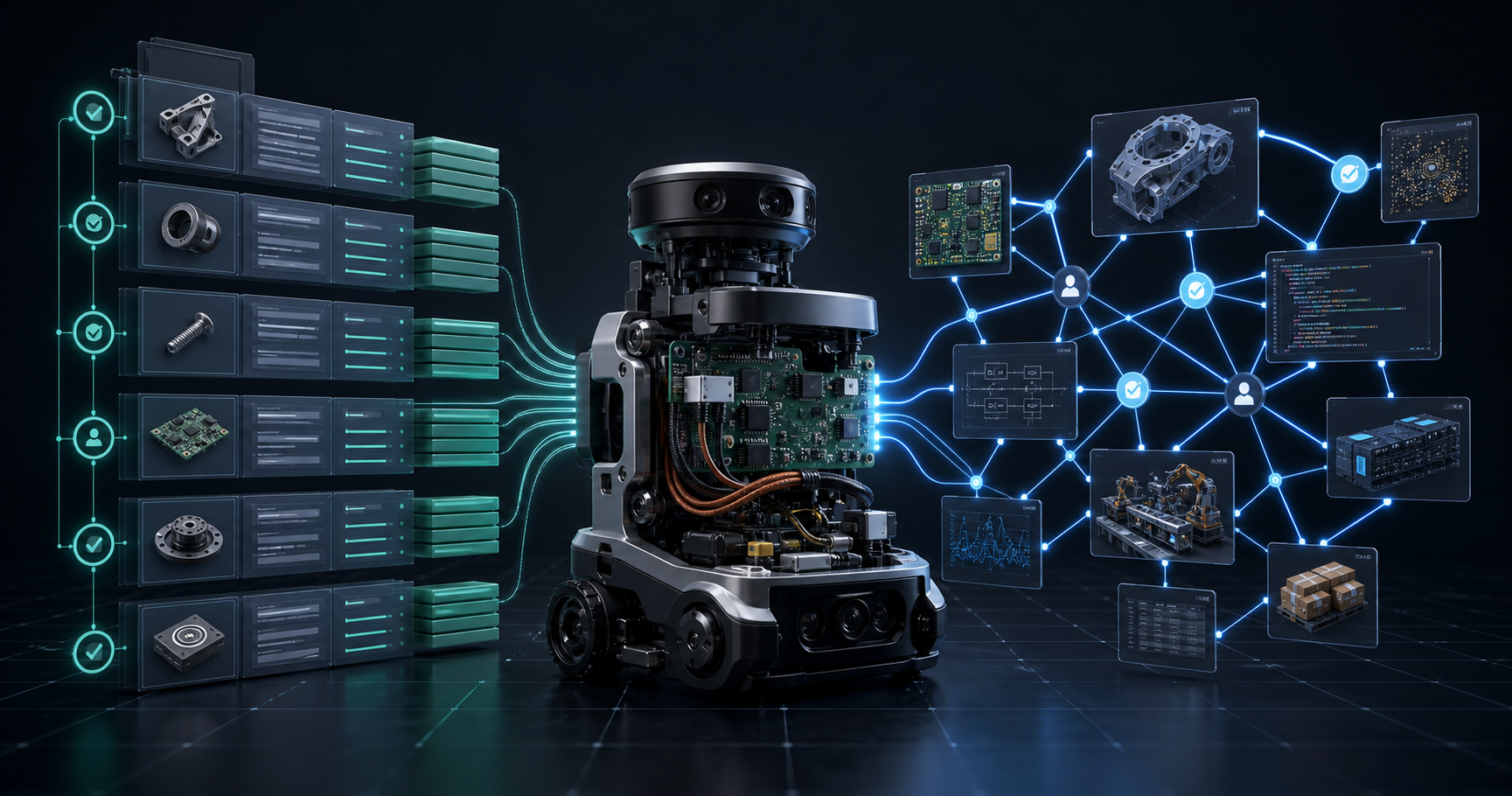
ProductFlo and Duro are easy to place in the same shortlist. Both are built for modern hardware teams. Both connect engineering data across disciplines. Both use AI to reduce manual coordination. Both want to replace the slow, fragmented workflows that emerge when CAD, BOM, sourcing, firmware, and manufacturing data stop agreeing.
But they enter the problem at different layers.
Duro is primarily a PLM system of record. ProductFlo is primarily an orchestration and design-review layer across the tools and records you already have. That distinction matters more than a feature-by-feature scorecard.
This comparison reflects publicly available product information reviewed on August 18, 2026. Product capabilities, plan limits, certifications, and integration status can change, so verify anything material during procurement.
Disclosure: This article is published by ProductFlo. We have tried to make the comparison useful and fair, link to first-party sources, and separate public facts from our interpretation. You should still run the same real workflow in both products before buying either one.
The short answer
Choose Duro when your immediate problem is establishing a modern PLM backbone: a controlled source of truth for parts, BOMs, revisions, change orders, approvals, sourcing, and downstream ERP or MES connections.
Choose ProductFlo when your immediate problem is understanding and governing changes across mechanical, electrical, firmware, BOM, supplier, and manufacturing systems without replacing those systems. ProductFlo indexes those artifacts into a typed product graph, runs scoped design-review agents, and returns proposed changes to humans as reviewable diffs.
Consider both when you want Duro to remain the authoritative PLM while ProductFlo supplies cross-discipline context, agent-driven review, and governed automation above it.
The choice is not simply “PLM versus AI.” Duro rebuilt its platform in 2025 as an AI-native, API-first PLM. The more useful question is: where should product truth live, and which system should reason across it?
ProductFlo vs. Duro at a glance
| Dimension | ProductFlo | Duro |
|---|---|---|
| Primary job | Orchestrate engineering context, reviews, and governed change across existing tools | Serve as the PLM source of truth for product data and lifecycle workflows |
| Core model | Typed product graph spanning ME, EE, firmware, BOM, suppliers, and manufacturing | Part-, BOM-, revision-, and workflow-centered digital thread |
| AI posture | Named, scoped agents read the graph and propose reviewable diffs | AI embedded in PLM for validation, impact analysis, search, metadata, sourcing, and BOM optimization |
| Change control | Proposal-first; agents do not commit directly | PLM change requests, change orders, approvals, and traceability |
| Integration strategy | Index in place through parsers, plugins, APIs, webhooks, and MCP | Synchronize product records through CAD, ERP, MES, requirements, sourcing, and collaboration integrations |
| Deployment posture | Publicly offers single-tenant cloud, self-hosted, and hybrid options | Cloud PLM with multi-tenant, dedicated, and ITAR-hosting options |
| Public buying model | Public pilot and annual Team pricing; custom Enterprise plan | Fixed annual subscription by tier; quote-based pricing and a qualified two-week trial |
| Best starting point | Teams keeping a mixed toolchain that need cross-discipline reasoning and review | Teams replacing spreadsheets or legacy PLM with a modern system of record |
The fundamental difference: control plane versus system of record
The cleanest way to understand Duro is as a modern product-data backbone.
Duro describes Duro Design as an AI- and cloud-native PLM that centralizes part data, manages change orders, and builds a digital thread from design through production. Its BOM becomes the foundation for approvals, revisions, sourcing, and connected manufacturing workflows. That is what a system of record should do: establish which product definition is released, who approved it, and what the organization should build.
ProductFlo starts from a different observation: the complete product definition rarely lives in one system.
Mechanical geometry may live in SolidWorks. The schematic and PCB may live in Altium or KiCad. Firmware lives in Git. Sourcing data changes in supplier systems. Requirements, test evidence, and manufacturing instructions have their own owners. A PLM can reference these artifacts, but cross-discipline design intent can still disappear between them.
ProductFlo's architecture indexes those sources in place and converts their contents into typed, linked objects: parts, assemblies, nets, pins, requirements, BOM lines, firmware symbols, suppliers, revisions, and decisions. It acts as a control plane for understanding dependencies and governing changes across systems rather than requiring every engineering activity to move into a new vault.
This leads to two different procurement questions:
- Duro question: Where will our approved product record live?
- ProductFlo question: How will every affected discipline understand and review a change before it is approved?
Many teams genuinely need answers to both.
Architecture and data model
Duro: the BOM-centered digital thread
Duro organizes work around familiar PLM primitives: components, products, BOMs, revisions, files, sourcing data, change requests, change orders, and release workflows. Its public product materials emphasize immediate synchronization across CAD, ERP, MES, requirements, and collaboration tools.
This model is a strong fit when the organization needs to replace spreadsheets, shared drives, or a rigid legacy PLM with one controlled place for product data. Engineers, operations, procurement, and manufacturing can work from the same released definition without inventing a custom lifecycle process.
Duro also supports configuration through UI controls, YAML, and a GraphQL API. That is meaningful for teams that want PLM discipline without turning every workflow change into a consulting engagement.
ProductFlo: the typed engineering graph
ProductFlo's primary object is not a file or BOM row. It is a typed node connected to every dependency that gives it meaning.
A connector can be related to its schematic nets, firmware pin assignments, enclosure opening, approved supplier part, test requirement, and open ECO. When one of those objects changes, the graph supplies a machine-readable blast radius before a human has to reconstruct it in a design review.
That graph is designed for both people and agents. The same governed context can be reached through the ProductFlo interface, in-host plugins, API and SDK, or MCP gateway. The result is a shared reasoning surface above discipline-specific authoring tools.
The tradeoff is scope. A graph layer creates the most value when source access, parsers, identity mapping, and ownership rules are set up well. A PLM rollout asks, “What record should become authoritative?” A graph rollout also asks, “Which relationships must be understood across records?”
AI: both are AI-native, but the operating models differ
It would be inaccurate to describe Duro as a conventional PLM with a superficial chatbot. Duro's current materials describe built-in AI for predictive change analysis, natural-language validation rules, search, metadata, sourcing, and BOM optimization. These capabilities operate inside its PLM and digital-thread model.
ProductFlo takes an agent-first approach. Its public catalog includes agents for impact analysis, pin-map conflicts, BOM reconciliation, supply monitoring, compliance triggers, revision narratives, thermal checks, and Design-for-X review. The important design choice is not the agent names. It is the mutation model: agents are scoped to read context and propose changes, while humans approve reviewable diffs.
That difference changes the evaluation:
- Evaluate Duro's AI on how much PLM administration, validation, sourcing analysis, and change-workflow effort it removes.
- Evaluate ProductFlo's agents on how accurately they reason across native engineering artifacts, explain evidence, find affected owners, and draft safe changes.
In both cases, ask to see more than a generated summary. A serious evaluation should show the source evidence, permissions, approval path, audit record, failure behavior, and the exact boundary between a suggestion and a committed change.
Core capability comparison
Where Duro is strongest
Duro's public product and plan pages present a mature PLM center of gravity:
- BOM and part-data management
- Revision control and product release
- Change requests, change orders, approval routing, and traceability
- Sourcing and vendor-part information
- CAD-to-PLM publishing and automated data transfer
- ERP, MES, requirements, Slack, Jira, and Linear connections by plan
- Configurable part numbers, fields, validation rules, and ECO routing
- PDM options, export control, SSO, and dedicated hosting on applicable tiers
This is the practical machinery a team needs when it has no reliable product-data backbone.
Where ProductFlo is strongest
ProductFlo's center of gravity is cross-tool understanding and governed review:
- Native-file parsers for MCAD, ECAD, firmware, BOMs, documents, and source code
- A typed, versioned graph of engineering objects and dependencies
- Cross-discipline impact analysis before approval
- Pin-map, BOM, supply, thermal, compliance, and Design-for-X review agents
- Reviewable and reversible ECO-style diffs with discipline-aware routing
- In-host engineering experiences and a GitHub review gate
- REST API, SDK, webhooks, scoped tokens, and an MCP gateway for external agents
- Cloud, self-hosted, and hybrid deployment patterns
This is most valuable when the product is tightly coupled across domains and the costliest failures occur between systems rather than inside one system.
Integrations: compare the workflow, not the logo wall
Both vendors publish broad integration stories. Duro lists CAD plugins and connections across ERP, MES, requirements, procurement, communications, and project management. ProductFlo describes in-host plugins, artifact parsers, webhooks, custom connectors, and developer access through API, SDK, and MCP.
Do not score this category by counting logos. Integration depth varies, and “integration” can mean anything from attaching a file to parsing native semantics and writing governed changes back.
For each critical tool, ask both vendors to demonstrate:
- What objects are read?
- Are native relationships preserved or flattened into attachments and fields?
- Is sync one-way or bidirectional?
- How are identities, revisions, and conflicts reconciled?
- What happens when the source tool is unavailable?
- Can a proposed change be written back without bypassing approval?
- Is the connector generally available, limited, or still under development?
A reliable answer to those questions matters more than a marketplace badge.
Security, compliance, and deployment
Duro states that it maintains a SOC 2 Type 2 report and offers multi-tenant, dedicated, and ITAR hosting options. Its plan page places dedicated or ITAR hosting in its higher-tier capabilities. Buyers should confirm the exact environment, data residency, export-control boundary, subcontractors, incident obligations, and whether every required integration is inside the authorized environment.
ProductFlo publicly offers single-tenant cloud, self-hosted Kubernetes, air-gapped, and hybrid deployment patterns, along with SSO, SCIM, RBAC, scoped agent credentials, and audit logs that record model, prompt, and diff information.
ProductFlo has completed a SOC 2 Type I audit. Buyers can request the current audit report and should apply the same evidence-first review to every vendor's certification claims.
For regulated or defense programs, evaluate the complete runtime boundary. Self-hosting a graph is not enough if an external model, telemetry service, connector, or support workflow moves controlled data outside it.
Pricing and buying model
ProductFlo currently publishes a $8,000, 30-day pilot, a Team plan starting at $48,000 per year, and custom Enterprise pricing. The pilot covers one active product and up to three source-tool integrations, with the pilot credit applied to an annual contract. Public Team positioning targets hardware organizations with 10–50 engineers.
Duro's plan page publishes plan structure rather than dollar amounts. As of this review, it lists Team for up to 14 users, Business for up to 24 users, and Enterprise for 25 or more users, with increasing storage and capabilities. Duro describes pricing as a fixed annual subscription and offers a two-week trial after qualification.
Those models reflect the products' different units of value:
- Duro packaging is oriented around PLM users, capacity, and enterprise workflow capabilities.
- ProductFlo packaging is oriented around products, artifact sources, agents, and the engineering organization being coordinated.
Compare total cost around a real workflow. Include implementation, connector work, migration or mapping, security review, model usage, support, administration, and the internal labor still required after go-live.
Which is a better fit for your team?
Start with Duro if you need to establish the record
Duro is likely the more direct starting point when:
- Parts and BOMs still live in spreadsheets or disconnected files.
- Released revisions are difficult to identify.
- Change approvals are informal or inconsistent.
- Operations and manufacturing need a dependable product record.
- You want a cloud PLM with out-of-the-box lifecycle workflows.
- Your immediate success metric is faster, more traceable release management.
Start with ProductFlo if you need to understand the system
ProductFlo is likely the more direct starting point when:
- You already have CAD, Git, BOM, or PLM systems you intend to keep.
- Mechanical, electrical, firmware, and manufacturing changes frequently collide.
- Design reviews spend too much time reconstructing downstream impact.
- You want agents to review native artifacts, not only summarize records.
- Every AI-generated change must remain scoped, reviewable, and auditable.
- Self-hosted or hybrid orchestration is important to your deployment model.
Use both if the layers are complementary
A practical combined architecture could use Duro as the authoritative home for parts, BOMs, approved revisions, change orders, and ERP or MES handoff. ProductFlo could index Duro alongside CAD, ECAD, firmware, requirements, and supplier data; run cross-discipline checks; and return approved changes through governed integrations.
That combination only makes sense if responsibilities are explicit. Define which system owns each object, where approvals happen, how conflicts are resolved, and which audit record is authoritative. Two platforms without ownership rules create two sources of confusion.
A better evaluation than a generic demo
Give both vendors one change that crosses disciplines. For example:
A supplier marks a connector end-of-life. The alternate changes the footprint, current rating, firmware pin assignment, enclosure opening, assembly instruction, and compliance evidence.
Then measure:
- Time to ingest and map the relevant product
- Accuracy of the affected-item list
- Quality and traceability of source evidence
- Ability to distinguish certainty from inference
- Correct owner and reviewer selection
- Clarity of the proposed BOM, CAD, firmware, and workflow changes
- Permission boundaries and human approval gates
- Write-back behavior and rollback path
- Audit completeness
- Time for a new engineer to understand the result
If your main need is PLM, also test product release, revision comparison, sourcing, ECO routing, and ERP or MES synchronization. If your main need is orchestration, add pin-map, thermal, compliance, and cross-artifact conflict tests.
The vendor that wins the staged demo may not win this exercise. That is the point.
Final verdict
ProductFlo and Duro overlap, but they are not interchangeable.
Duro is the clearer choice when you need a modern PLM system of record. ProductFlo is the clearer choice when you need a governed intelligence and orchestration layer across an existing, mixed engineering stack. A complex hardware organization may ultimately use both layers.
Start with the failure you need to prevent. If the recurring question is “which revision is approved?”, fix the record. If it is “what else breaks when this changes?”, fix the context and review layer. If your team cannot answer either question reliably, design the two layers together instead of forcing one platform to pretend it is both.
To evaluate ProductFlo on one of your own cross-discipline changes, book a working session. Bring the real CAD, ECAD, firmware, BOM, or PLM workflow that currently costs your team the most time.
Primary sources
Stop bad hardware changes before they ship.
30-day pilot on one active product. Fixed $8k. Live on your own BOM in week one.