ProductFlo vs. Flow Engineering: Design Orchestration or Systems Engineering?
ProductFlo and Flow both use graphs and AI agents for hardware teams. Compare design orchestration, requirements, V&V, integrations, security, pricing, and fit.
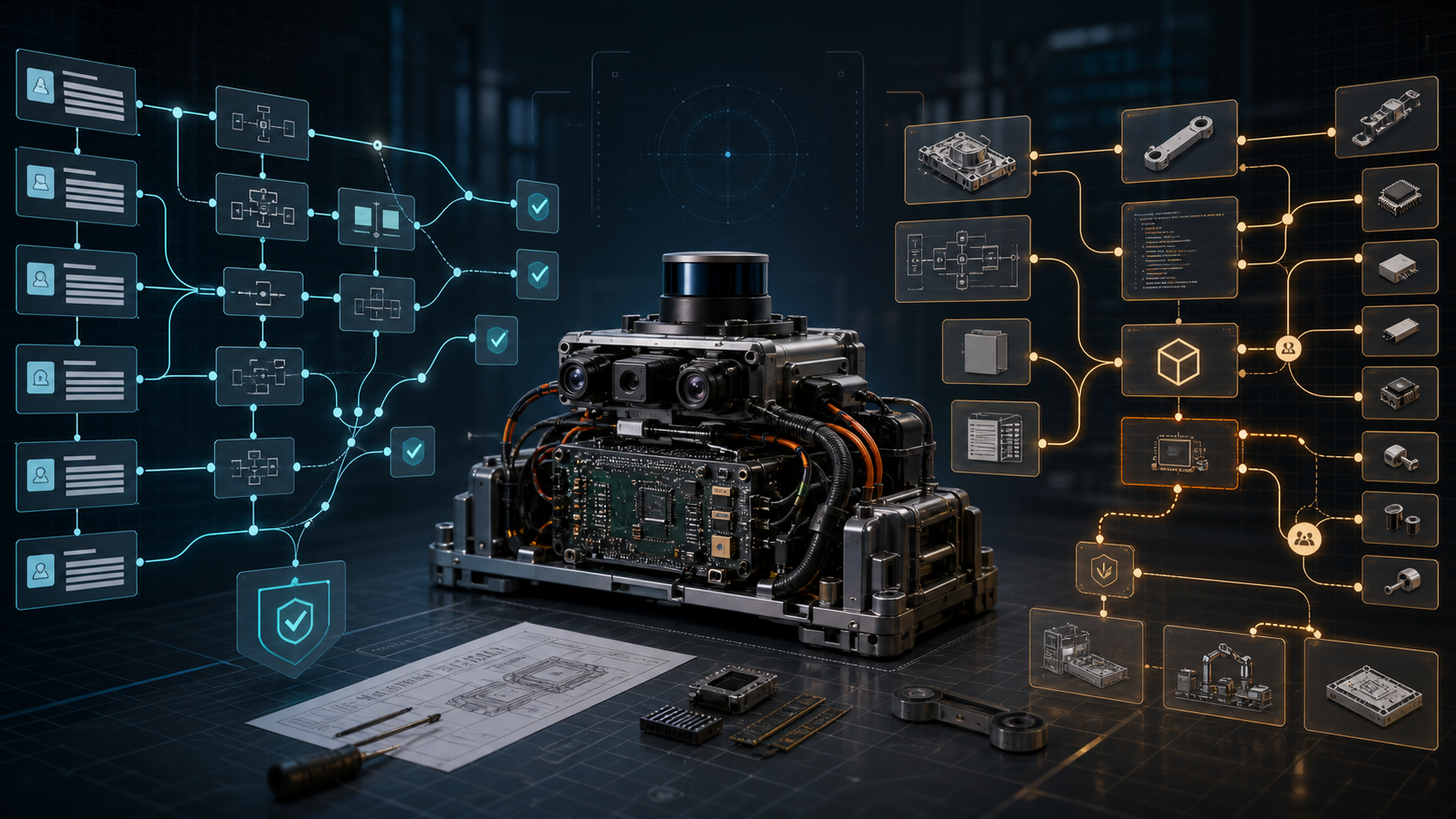
ProductFlo and Flow Engineering are unusually easy to confuse from a distance.
Both are AI-native platforms for hardware teams. Both build graphs across engineering data. Both run agents against that context. Both use software-style ideas such as branches, diffs, review gates, and automation to help physical-product teams move faster without losing control.
The difference appears when you ask what each graph is meant to govern.
Flow is centered on requirements, systems architecture, interfaces, tests, and verification. ProductFlo is centered on native design artifacts, cross-discipline dependencies, design review, and governed engineering change. Flow begins with the system definition and keeps implementation traceable to it. ProductFlo begins with the implementation artifacts and makes their downstream impact reviewable across mechanical, electrical, firmware, BOM, supply, and manufacturing.
This comparison reflects public product information reviewed on August 18, 2026. Capabilities, integration status, pricing, and compliance claims can change, so verify anything material during procurement.
Disclosure: This article is published by ProductFlo. We have linked to Flow's first-party materials, corrected claims that were no longer current, and tried to separate public facts from our interpretation. You should still test both products on the same engineering change before buying either one.
The short answer
Choose Flow Engineering when your main problem is maintaining a living requirements and systems-engineering baseline: requirements, interfaces, architecture, risks, test cases, verification coverage, and program variants that must remain aligned as a complex system evolves.
Choose ProductFlo when your main problem is detailed design drift across CAD, ECAD, firmware, BOM, suppliers, and manufacturing: changes are difficult to review, ECO cycles are slow, and engineers manually reconstruct what a change breaks across disciplines.
Consider both when Flow should own the requirement-to-verification thread while ProductFlo supplies design-level understanding and governed review across the implementation toolchain.
This is not a simple “requirements tool versus AI tool” comparison. Flow describes itself as requirements management plus AI agents operating over a living systems graph. ProductFlo is also graph- and agent-native. The more useful distinction is systems intent versus implementation context.
ProductFlo vs. Flow at a glance
| Dimension | ProductFlo | Flow Engineering |
|---|---|---|
| Primary job | Cross-discipline design review and governed change across existing engineering tools | Requirements, systems engineering, architecture, testing, and verification alignment |
| Starting point | Native CAD, ECAD, firmware, BOM, supplier, document, and manufacturing artifacts | Requirements, interfaces, systems, design units, test cases, simulations, and compliance evidence |
| Graph model | Typed product graph of detailed engineering objects and dependencies | Living systems graph of the full program and its traceability relationships |
| AI posture | Scoped design-review agents propose reviewable ECO-style diffs | Systems-engineering agents analyze impact, coverage, budgets, compliance, and downstream alignment |
| Change model | Proposed diff or ECO with discipline-aware human review | Branch-and-merge model with a protected baseline and required reviewers |
| Strongest control point | Implementation consistency across ME, EE, firmware, BOM, supply, and manufacturing | Requirements-to-architecture-to-test traceability and program-level V&V |
| Integration posture | Native parsers, in-host plugins, API, SDK, webhooks, and MCP | Integrations across documents, source control, planning, CAD, analysis, and collaboration tools |
| Deployment | Single-tenant cloud, self-hosted, air-gapped, or hybrid | Cloud, AWS GovCloud, or self-hosted |
| Public pricing | $8,000 pilot; Team from $48,000/year; custom Enterprise | Basic $150/editor/month; Pro $300/editor/month; custom Enterprise |
Why this comparison is more nuanced than it first appears
ProductFlo and Flow overlap more directly than ProductFlo and a conventional PLM.
Flow's current product is not limited to writing requirements in a database. Its Systems Graph links requirements, interfaces, architecture, design units, test cases, simulations, software components, and compliance evidence. Agents can ingest PDFs, CAD files, GitHub repositories, and supplier specifications, then flag downstream requirements and tests when a source changes.
ProductFlo's graph also links requirements and design decisions, but its center of gravity sits deeper in the implementation. Parts, assemblies, nets, pins, tolerances, BOM lines, firmware symbols, suppliers, and revisions become typed objects that design-review agents can inspect together.
Both platforms therefore promise impact analysis. The question is what evidence they understand most deeply and what workflow receives the result.
- Flow asks: Which requirements, interfaces, tests, configurations, and certification evidence become suspect?
- ProductFlo asks: Which design artifacts, disciplines, parts, connections, owners, and release decisions must change?
The same supplier update may need both answers.
Architecture and data model
Flow: the living systems baseline
Flow presents the systems graph as a continuously updated model of an engineering program. Requirements, architecture, interfaces, tests, CAD, simulations, source documents, and compliance evidence are nodes with explicit relationships.
That structure supports classic systems-engineering questions in a more iterative workflow:
- Which lower-level requirements satisfy this system requirement?
- Which tests verify it?
- Which interface or configuration depends on it?
- What must be retested if a parameter changes?
- Which supplier or program variant inherits the change?
- Is the evidence behind a baseline still valid?
Flow adds a Git-like change model. Every proposed change can live on a branch, where teams compare diffs, run impact analysis, collect required reviews, and merge only after approval. The baseline remains stable while alternatives, supplier work, test updates, and program variants move in parallel.
This is especially valuable for organizations where PDR, CDR, certification, supplier reviews, and multiple product variants must coexist without freezing engineering work.
ProductFlo: the typed implementation graph
ProductFlo indexes the tools engineers already use and parses native artifacts into typed, versioned objects. A connector is not only a file reference or BOM entry. It can be related to schematic nets, firmware pin assignments, enclosure geometry, approved supplier parts, test requirements, and open change orders.
The graph is designed to make implementation dependencies queryable before a change is approved. ProductFlo's agents can ask whether a firmware change still matches the schematic, whether a replacement part affects the mechanical envelope, whether a duty-cycle change breaks a thermal budget, or whether an ECO invalidates compliance evidence.
ProductFlo's public architecture emphasizes reviewable diffs and ECOs rather than branches as the primary unit of governance. Agents propose. Discipline-appropriate owners review. Approved changes synchronize through plugins or APIs.
The value grows with cross-discipline coupling. A product with tightly linked mechanical, electrical, firmware, sourcing, and manufacturing constraints creates more useful implementation relationships than a set of mostly independent subsystems.
AI agents and human control
Both platforms reject the idea that an agent should silently rewrite the authoritative product definition.
Flow says agents work on branches and that a human approves every merge into the baseline. Its public materials describe impact-analysis, mass/cost/power-budget, safety and regulatory, test-coverage, and custom agents. When a source artifact changes, an agent can open a branch, prepare downstream updates, mark evidence stale, and notify affected owners.
ProductFlo's agents run with scoped credentials and propose-only behavior. Public examples include impact analysis, pin-map validation, BOM reconciliation, supply monitoring, thermal review, compliance triggers, revision narratives, and Design-for-X checks. Every mutation returns a reviewable diff rather than a direct commit.
This shared human-control principle is important, but buyers should test the implementation details:
- What source context did the agent actually retrieve?
- Can the user distinguish direct evidence from inference?
- Which permissions constrain the agent's reads and proposed writes?
- How are required reviewers selected?
- What happens when sources disagree or are unavailable?
- Does the audit record include the model, prompt, retrieved evidence, user, and resulting change?
- Can the proposal be rejected or rolled back without contaminating the baseline?
“Human in the loop” is only meaningful when the human receives enough evidence to make the decision.
Requirements, test, and V&V workflows
Flow is the clearer fit when requirements and verification are the primary operating system of the program.
Its public plans include core requirements, test cases and plans, and MBSE across every tier. Requirements can be parameterized and linked to live values. Test cases trace back to the requirements they cover. A source update can mark a requirement suspect, invalidate a test, or stale certification evidence before the problem reaches a formal review.
Flow also has public proof of enterprise-scale requirements use. Flow says more than 1,000 Rivian engineers use it as the requirements system of record across R1 and R2 vehicle programs, with an evaluation target of more than one million requirements and 1,000 concurrent users. In July 2026, Flow announced a three-year partnership with Rivian and Volkswagen Group Technologies focused on keeping requirements, architecture, and verification aligned across brands and vehicle programs.
ProductFlo can connect requirements to implementation objects and use them in impact or compliance review. But teams shopping primarily for requirement authoring, architecture trees, verification coverage, program branching, and MBSE should evaluate Flow's native workflows first rather than treating ProductFlo as a substitute requirements system.
Detailed design and release workflows
ProductFlo is the clearer fit when the recurring failure happens inside or between detailed engineering artifacts.
Examples include:
- A PCB net name and firmware pin assignment no longer match.
- An alternate component changes the footprint, current rating, or approved vendor list.
- A mechanical revision collides with the live PCB outline.
- A firmware duty-cycle change exceeds the thermal or power envelope.
- Design, manufacturing, and PLM BOMs have drifted.
- A design change reopens an FCC, UL, IEC, or medical-device evidence gate.
- A firmware pull request should not merge until the hardware graph agrees.
ProductFlo's native parsers, typed design objects, in-host experiences, GitHub review gate, and governed ECO flow are built around that layer of detail.
Flow is expanding its connections to CAD, simulation, PLM, and manufacturing tools, and its systems graph can surface design changes against requirements. But buyers should test whether each connector extracts the native implementation semantics needed for their use case or primarily links parameters and source records back to the systems baseline.
Integrations: availability matters as much as vision
Flow publishes a particularly useful integration catalog that separates current connections from those marked “Coming Soon.”
Current public integrations include GitHub, GitLab, Onshape, Excel, Google Sheets, SharePoint, Jira, Linear, Notion, Confluence, Slack, Python, Cursor, Google Drive, and Relyence. The capabilities vary: Onshape can provide lengths, masses, and volumes for requirement checks; GitHub can rerun calculation scripts and compare results; planning and document tools keep linked context current.
Flow currently labels integrations such as Altium 365, Ansys, Duro, Epsilon3, Fusion 360, MATLAB, Microsoft Teams, SimScale, Siemens NX, and SolidWorks as coming soon. Do not buy roadmap items as if they were deployed functionality.
ProductFlo publicly describes integrations through native artifact parsers, in-host plugins, GitHub automation, API/SDK access, webhooks, MCP, and custom connectors. Its own public pages also contain mixed availability labels for some CAD and ECAD integrations, so buyers should request a connector-by-connector status and demonstrate the exact production path.
For either platform, ask:
- What objects and relationships are extracted?
- Is synchronization one-way or bidirectional?
- Is the connector generally available, limited, or roadmap?
- How are revisions, identities, conflicts, and deleted objects reconciled?
- Can approved changes write back without bypassing the source system's controls?
- Does the integration work inside the required cloud, GovCloud, or self-hosted boundary?
A long logo wall is not an integration architecture.
Security, compliance, and deployment
Flow's security page states that Flow supports cloud, AWS GovCloud, and fully self-hosted deployment. It lists SOC 2 Type II, ITAR and EAR alignment, NIST 800-171 controls, CUI handling, SAML SSO, SCIM, granular roles, private inference, AI audit trails, and a commitment not to use customer prompts, documents, or outputs for model training.
ProductFlo has completed a SOC 2 Type I audit. ProductFlo publicly offers single-tenant cloud, self-hosted Kubernetes, air-gapped, and hybrid patterns, with SSO, SCIM, RBAC, scoped agent credentials, customer-controlled model options, and audit logs covering model, prompt, and proposed diff.
That gives Flow the stronger public certification claim today, while both vendors present deployment options for controlled environments.
Security procurement should still inspect the complete runtime rather than the marketing label. Confirm where graph data, source artifacts, embeddings, prompts, logs, support access, connector credentials, and model inference live. Ask which evidence applies to the exact environment you will buy, not only the vendor's default SaaS tenant.
Pricing and buying model
The supplied comparison described Flow as quote-only, but Flow now publishes pricing.
Flow's current plans list:
- Basic: $150 per editor per month, with 500 requirements, one project, all integrations, API access, and a viewer license.
- Pro: $300 per editor per month, with 5,000 requirements, five projects, all features, and priority support.
- Enterprise: Custom per-editor pricing with unlimited requirements, projects, and configurations, plus ITAR AWS GovCloud, custom integrations, advanced access controls, and enterprise support.
- Trial: A self-service 14-day trial is publicly available.
ProductFlo currently publishes:
- Pilot: $8,000 for 30 days, covering one active product and up to three source-tool integrations, with the pilot credit applied to an annual agreement.
- Team: From $48,000 per year for a full product graph, agents, plugins, and enterprise access controls.
- Enterprise: Custom pricing for self-hosting, compliance, support, or volume requirements.
The buying units reveal the product focus. Flow scales around editors, requirements, projects, configurations, and systems-program controls. ProductFlo scales around products, artifact sources, graph coverage, agents, and the multidisciplinary engineering organization being coordinated.
Model total cost around a live workflow. Include source mapping, migration, connector maturity, integration engineering, permissions, model inference, support, and the internal effort still required to keep the graph trustworthy.
Which is a better fit for your team?
Start with Flow if systems intent is the missing backbone
Flow is likely the better first investment when:
- Requirements and architecture are scattered across documents and legacy tools.
- Verification coverage is difficult to measure or keep current.
- Multiple programs, variants, suppliers, or brands share a baseline.
- PDR, CDR, certification, and test campaigns must continue while engineering iterates.
- Systems engineers spend too much time maintaining links and traceability.
- AWS GovCloud, NIST 800-171, CUI handling, or SOC 2 Type II is a procurement requirement.
Start with ProductFlo if implementation coordination is the bottleneck
ProductFlo is likely the better first investment when:
- You intend to keep your CAD, ECAD, Git, BOM, and PLM tools.
- Mechanical, electrical, firmware, sourcing, and manufacturing frequently drift.
- Design reviews manually reconstruct downstream impact.
- You need agents that inspect native schematics, code, CAD, BOM, and supplier data together.
- ECOs should arrive with evidence, owners, cross-discipline impact, and proposed diffs.
- Self-hosted or hybrid design-review automation is important.
Use both when intent and implementation need separate owners
A combined architecture can be coherent:
- Flow owns the requirements, system architecture, interfaces, verification links, variants, and approved systems baseline.
- A requirement change opens a Flow branch and identifies affected design units, tests, suppliers, and certification evidence.
- Engineers implement the change in CAD, ECAD, firmware, BOM, and manufacturing tools.
- ProductFlo indexes those native changes and runs detailed pin-map, thermal, BOM, supply, compliance, and Design-for-X review.
- ProductFlo returns a governed ECO-style proposal for human approval.
- Approved implementation evidence flows back to Flow so requirements and verification coverage reflect what was actually built and tested.
This only works if ownership is explicit. Define which platform owns requirements, design objects, review decisions, baselines, ECOs, test results, and audit evidence. Two graphs without an ownership model create a new reconciliation problem.
A practical evaluation scenario
Give both vendors one change that begins at system intent and ends in production detail:
Increase cold-weather charging performance. The requirement changes the thermal envelope, power budget, battery-control firmware, cooling hardware, connector ratings, simulation assumptions, test plan, supplier specification, and certification evidence.
Then measure:
- Time to ingest and map the live program
- Accuracy of upstream and downstream traceability
- Native depth of CAD, ECAD, code, BOM, test, and document understanding
- Quality of impact analysis and requirement-suspect flags
- Correct test invalidation and coverage reporting
- Correct implementation conflicts and affected-owner selection
- Branch, diff, approval, and baseline behavior
- Evidence quality and separation of fact from inference
- Connector write-back and failure handling
- Audit completeness and deployment-boundary compliance
- Time for an engineer outside the originating team to understand the decision
Flow should prove the system-level thread. ProductFlo should prove the design-level consequences. If a vendor claims both, make it demonstrate both using your data.
Final verdict
ProductFlo and Flow are not opposites. They are two different answers to the same underlying problem: hardware teams cannot move at software speed while engineering context remains fragmented.
Flow is the clearer choice for a living requirements and systems-engineering backbone with program-level traceability, branching, and V&V. ProductFlo is the clearer choice for detailed cross-discipline design understanding, agent-driven review, and governed engineering change across an existing toolchain.
Choose the layer where your organization loses control today. If engineers cannot prove that implementation satisfies intent, start with Flow. If they cannot tell what the implementation change breaks, start with ProductFlo. If both failures are common, design the handoff between system intent and detailed design instead of asking one tool to obscure the boundary.
To evaluate ProductFlo on a real cross-discipline change, book a working session. Bring the CAD, ECAD, firmware, BOM, supplier, or manufacturing workflow that currently consumes the most review time.
Primary sources
- ProductFlo product, architecture, agent, deployment, and pricing overview
- Flow Engineering product overview
- Flow Systems Graph
- Flow branching and baseline model
- Flow integration catalog and roadmap labels
- Flow security and deployment
- Flow pricing
- Flow at Rivian
- Flow and Rivian Volkswagen Group Technologies
Stop bad hardware changes before they ship.
30-day pilot on one active product. Fixed $8k. Live on your own BOM in week one.