Your PLM needs to make your team autonomous.
When buying from a young company, the goal is not to eliminate startup risk. The goal is to bound the downside so the upside becomes rational.
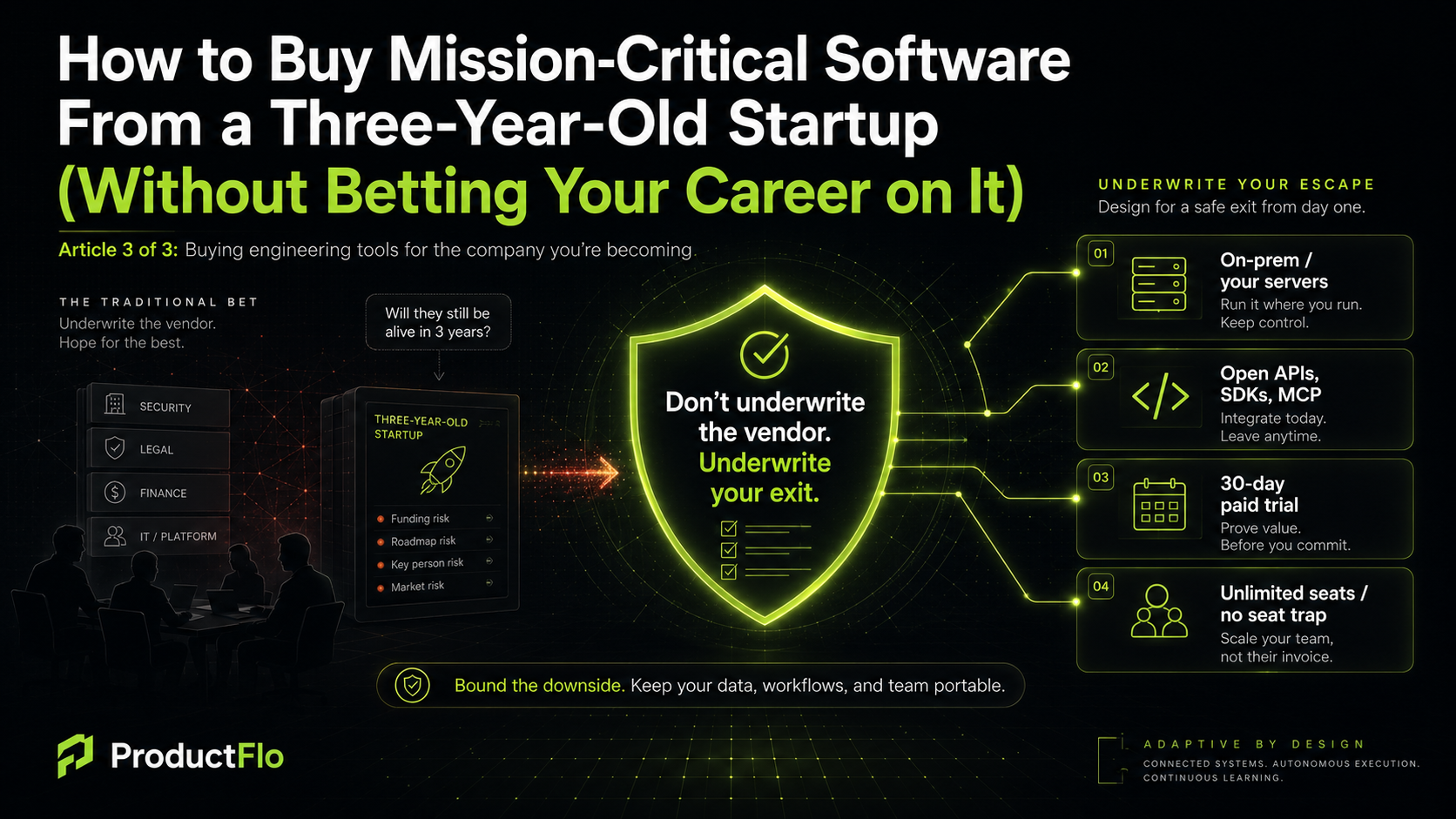
How to Buy Mission-Critical Software From a Three-Year-Old Startup (Without Betting Your Career on It)
Article 3 of 3: Buying engineering tools for the company you're becoming
On a sales call recently, a buyer asked me the question every startup founder dreads and every serious buyer should ask:
"Will you still be alive in three years?"
He wasn't being hostile. He was two months into a new role, pushing his company toward modern tooling against colleagues who wanted the safe incumbent, and he knew exactly what happens to the person who championed the vendor that folded. His career was in the room alongside my product.
I gave him the honest answer: I can't guarantee ten years. I can point to our runway, our customers, our trajectory — but a guarantee would be a lie, and buyers can smell it. What I can do is something better than a promise: architect the engagement so that my survival isn't his problem.
That reframe is the whole article. If you're evaluating young vendors for infrastructure roles — PLM, ERP, anything that becomes a system of record — here's the framework I'd want you to use on me and on every competitor.
Stop underwriting the vendor. Underwrite your exit.
Traditional procurement tries to predict vendor survival: funding rounds, customer logos, revenue signals. Do that diligence — but recognize its limits. You cannot reliably predict which startups survive five years. Nobody can, including the founders.
What you can control is the cost of being wrong. The right question isn't "will they survive?" It's: "If this vendor disappears on the worst possible Tuesday, what happens to my data, my workflows, and my team — and how long does recovery take?" A startup with a good answer to that question is a safer purchase than an incumbent with a bad one. (And incumbents have bad answers more often than you'd think — ask anyone who's tried to exit a decade-old PLM with proprietary data formats.)
Four things determine that answer.
The four escape hatches
1. Where does the data live? If the answer is "our cloud," vendor death means data hostage negotiation with a bankruptcy trustee. If the answer is "your servers, on-prem, you own the deployment" — vendor death means the software keeps running exactly as it did yesterday, and you migrate on your own schedule. For defense and med-tech companies this is table stakes for compliance reasons anyway, but every buyer should treat deployment model as a survival hedge, not just a security checkbox.
2. Is the interface open? A system with real APIs, SDKs, and an MCP surface has a property that changes the risk math entirely: you can extend it without the vendor. If the company behind it slows down or disappears, your own engineers — or frankly, a coding agent pointed at good documentation — can build the missing feature, the export pipeline, the integration. Closed systems make the vendor's roadmap your ceiling. Open systems make it your floor.
3. Can you try before you marry? Be suspicious of any vendor — young or old — whose smallest unit of commitment is a multi-year contract. A structured paid trial (we run 30 days, no contract, no engagement) exists precisely so the trust question gets answered by evidence instead of references. A startup confident in its product will let the product argue. One that won't is asking you to absorb risk it should be carrying.
4. What's the seat-and-usage trap? Per-seat pricing on a coordination tool is a quiet exit barrier: it forces you to ration access, which concentrates knowledge in a few licensed users, which deepens your dependence on the vendor's specific workflow. Flat, unlimited-seat models aren't just cheaper at scale — they keep your organizational knowledge diffuse and portable.
The internal-selling script
If you're the champion — the person who has to defend this choice to a procurement committee and a skeptical engineering lead — here's the argument structure that actually survives the meeting:
"I'm not asking us to bet on this vendor's survival. The deployment is on our servers, so the software outlives the company. The data is ours in open formats, so migration is always available. The APIs mean our team can extend it independently. And we're validating all of this in a 30-day trial before any annual commitment. Our downside is bounded and known. Meanwhile, the incumbent's downside — a system our engineers route around, no AI trajectory, and a proprietary-format exit that gets more expensive every year — is unbounded and growing."
Notice what that does: it converts "startup risk" from a character judgment about the vendor into an architecture checklist you verified yourself. Committees can't argue with checklists they can audit.
Why I'm telling you how to leave me
It might seem strange for a founder to publish an exit-planning guide for his own customers. But the incentive is cleaner than it looks: I want customers who chose us with clear eyes, because they're the ones who scale with us, extend us, and tell other people. A customer who feels trapped is churn with a delay timer.
And there's a bigger point. The hardware industry's tooling stagnated for two decades partly because buying was so terrifying that nobody switched, so nobody had to improve. Making it safe to try new tools — genuinely safe, architecturally safe — is how the whole category gets better. That's a world I'd rather build in.
If you missed them: part one of this series covered why scaling headcount, not product complexity, is the real trigger for tooling change. Part two covered how to weigh incumbent depth against AI-native adaptability. This one closes the loop: how to act on that analysis without putting your career in escrow.
I'm Serge Kadjo, founder of ProductFlo — a coordination layer that connects mechanical, electrical, and firmware engineering so changes propagate instead of getting lost. I've spent 10+ years building hardware, from consumer robotics to medical wearables, and I write about the intersection of AI and hardware engineering.
Stop bad hardware changes before they ship.
30-day pilot on one active product. Fixed $8k. Live on your own BOM in week one.